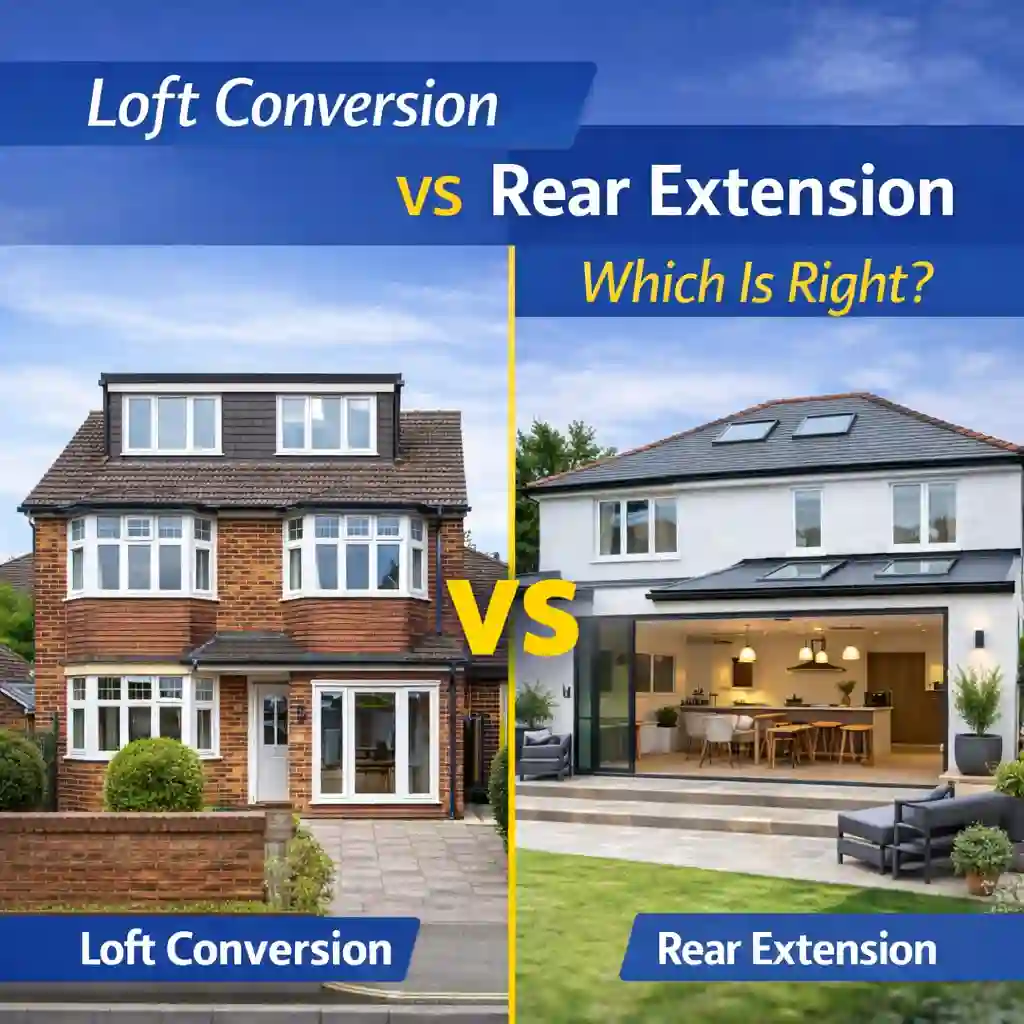
The best kitchen extensions are not just bigger kitchens. They are better-planned homes. In Surrey and the London-border family market, the kitchen extension has become the place where cooking, homework, entertaining, storage, utility tasks and everyday family life all need to work together. That is why a successful kitchen extension starts with lifestyle and layout before finishes. A beautiful room that still functions badly is not a success.

What current homeowner data says about kitchen priorities
Recent UK kitchen renovation research gives a useful picture of what people value most when they invest in kitchen-led projects.
| Topic | Recent UK homeowner insight | What it means for your project |
|---|---|---|
| Worktops | 92% of homeowners upgraded their worktops in recent or planned kitchen renovations. | Worksurface choice is usually a core design decision, not a late add-on. |
| Material preference | Engineered quartz led at 42%, followed by wood at 14%, laminate at 14%, solid surface at 12%, granite at 10% and marble at 5%. | Durability and maintenance often drive decisions as much as aesthetics. |
| Buying criteria | Look and feel (65%), durability (44%) and ease of cleaning (38%) outranked cost (24%). | Homeowners increasingly prioritise long-term performance over cheapest upfront choice. |
| Median spend | Median kitchen renovation spend rose to £17,500, with major large-kitchen projects reaching around £20,000. | Fit-out expectations can materially affect the total extension budget. |
| Splashbacks | 62% chose slab splashbacks and 38% chose tile. | Full-height, lower-joint and easy-clean finishes remain popular. |
| Cabinet colour mix | 31% chose different colours for upper and lower cabinets. | Two-tone kitchens remain mainstream rather than niche. |
Start with the right extension type
Different homes suit different kitchen-extension strategies. A Victorian or Edwardian terrace may benefit from a side return extension. A semi-detached suburban house may suit a generous rear extension. A home with both rear and side opportunity may justify a wrap-around extension that completely reworks the ground floor.
The goal is not simply to add area. It is to choose the footprint that creates the best circulation, the strongest light and the most coherent relationship with the garden.
Which kitchen-extension route often suits which home?
These are practical patterns rather than fixed rules.
| Extension type | Often suits | Main benefit |
|---|---|---|
| Rear extension | Semis, detached homes and family houses with enough plot depth. | Creates a wide kitchen-dining-family zone and improves rear-garden connection. |
| Side return extension | Terraces and period homes with redundant side passage space. | Makes narrow rear rooms wider and more functional without using as much garden depth. |
| Wrap-around extension | Homes with both rear and side potential where a full replan is worthwhile. | Can transform a fragmented ground floor into one coordinated family layout. |
| Single-storey extension | Most households looking to improve day-to-day living without creating upstairs space. | Usually the most direct kitchen-lifestyle upgrade. |
| Double-storey extension | Families needing both kitchen space and extra rooms above. | Can combine ground-floor lifestyle gains with upstairs accommodation. |
Materials should follow the way you live
Research suggests homeowners increasingly prioritise look and feel, durability and cleanability over lowest cost when choosing worktops. That makes sense in a family kitchen extension, where the room will likely work hard every day.
The same principle applies to flooring, joinery finishes, handles, splashbacks and paint. A family kitchen should still look good after school bags, dogs, entertaining, rushed breakfasts and winter garden traffic. Durable choices usually age better than overly precious ones.
Common layout priorities in family kitchen extensions
These are the questions that usually produce better design decisions than simply choosing a style.
| Layout priority | Why it matters | Design response |
|---|---|---|
| Sight lines to children and garden | Families often want the cook space visually linked to dining, seating and outside play space. | Consider where the main sink, hob or island seating should sit in relation to glazing and garden doors. |
| Mess control | Open-plan spaces can become visually busy very quickly. | Use pantry cupboards, utility spill space and hidden appliance storage to calm the room. |
| Daily circulation | Bad circulation makes even a large extension feel awkward. | Plan routes to the garden, WC, utility and dining space before fixing cabinetry. |
| Seasonal use | A bright summer room can still feel cold or glare-heavy if poorly balanced. | Think about insulation, shading, ventilation and how the room will feel in winter as well as summer. |
| Future flexibility | Family routines change. | Design enough adaptability for home working, older children, entertaining or accessibility needs later. |
Do not forget planning and technical compliance
Kitchen extensions are often discussed as design projects, but they are also approval projects. Depending on the size, position and property type, you may need planning permission, prior approval or a lawful development strategy.
Most extensions also need building regulations approval, and many kitchen-led ground floor projects have structural implications because the layout often relies on large openings between the old house and the new extension.
On suburban and terraced plots, the Party Wall etc. Act 1996 may also be relevant where you are excavating close to neighbours or working on shared structures.
Style trends are useful — but only after the layout is solved
Current UK kitchen data shows interest in slab splashbacks, two-tone cabinetry and a mix of contemporary, modern and traditional styles. These ideas can all work beautifully, but they should come after the hard questions on footprint, zoning, storage, light and structural feasibility are resolved.
That is why the most successful family kitchen extensions are usually those where the form, function and construction route have been aligned from the start through a joined-up design and build approach.
Frequently Asked Questions
It depends on the house. Rear extensions work well for many semis and detached homes, side returns suit narrow period houses, and wrap-around extensions are often best where a full ground-floor replan is worth doing.
Sometimes yes and sometimes no. Some kitchen extensions to houses can fall within permitted development rights, but the answer depends on size, position, restrictions and planning history.
Balance rear glazing with rooflights, side light where possible, sensible ceiling design and good internal zoning. More glass is not automatically better if it creates overheating, glare or reduced wall space.
Only if the room has the right proportions and circulation to support it. In some layouts a peninsular, dining banquette or more generous clear floor space is the smarter choice.
Recent UK homeowner data puts engineered quartz at the top of the list, followed by wood and laminate. Popularity alone should not decide the choice, but it shows the strength of demand for durable, low-maintenance surfaces.
It can, especially where it creates genuinely usable, attractive family living space. The biggest gains usually come when the extension fixes a poor layout rather than simply adding area.
Where space allows, many families find that separating laundry, storage and day-to-day clutter from the main kitchen dramatically improves how the room works.
Designing around appearance before solving layout, storage, circulation and buildability. A room can look impressive in a rendering and still function badly in real life.