
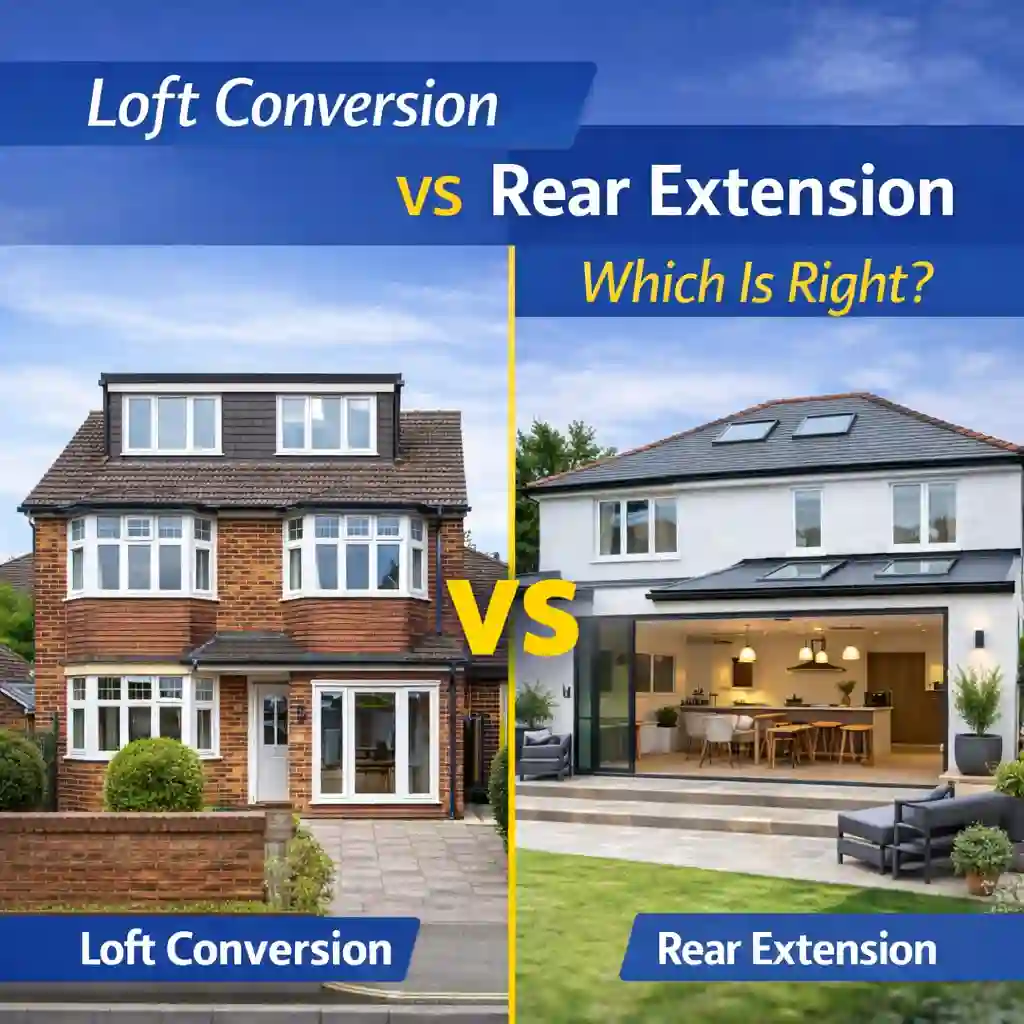
This is one of the most common early-stage decisions for homeowners. A loft conversion and a rear extension solve different problems. One gives you new space above the house; the other increases the footprint at ground floor level. Both can add value when they create genuinely useful accommodation, but they do not suit the same family needs, layout goals or property types. The best answer depends on what you want the space to do, how much disruption you can accept, and which planning and structural route is more realistic for the property.

At-a-glance comparison
The figures below are planning-stage guides rather than quotations. They are most useful when deciding which route deserves deeper design work.
| Question | Loft conversion | Rear extension |
|---|---|---|
| What space it usually creates best | Bedroom suite, study, nursery, guest room, sometimes an en-suite floor. | Open-plan kitchen-dining-family space, larger living area, utility, playroom or accessible ground-floor room. |
| Typical ballpark cost | Often around £27,500 to £75,000+ depending on type and structure. | Single-storey extensions often sit within broad ranges from around £40,000 to £84,000 for 20m² to 30m² standard schemes, with bigger or premium projects higher. |
| Planning route | Often permitted development for houses if volume and design limits are met, but not always. | Can sometimes be permitted development, but deeper, wider or more complex layouts often move into planning or prior approval. |
| Building regulations | Always important and generally required for habitable loft space. | Most extensions require building regulations approval. |
| Effect on garden | Usually none. | Usually reduces garden or patio area. |
| Effect on daily family life | Can be less intrusive to the main kitchen/living space for some phases, but roof works are still disruptive. | Often more disruptive to the existing rear of the house, especially if the kitchen is being remodelled. |
| Main design compromise | You need a staircase and enough head height; the best part of the new floor is usually central. | You use external footprint and may change how the garden and rear elevation work. |
| Value potential | Useful extra bedrooms can be very attractive to buyers where the room is genuinely usable. | Ground-floor family space and better kitchen layouts can also be highly saleable in family suburbs. |
When a loft conversion usually wins
A loft conversion is often the stronger choice where the real problem is bedroom pressure. If you need an extra bedroom, home office, teenage suite or guest room and you already like the footprint of the ground floor, adding space in the roof can be very efficient.
It can also be the better answer where preserving the garden matters. In tighter suburban plots around Elmbridge, a rear extension can eat valuable outside space quickly, while a loft conversion leaves the footprint alone.
However, loft success depends heavily on the existing roof structure, head height, the stair position and whether the new room will feel genuinely comfortable. A technically possible loft is not always a commercially sensible loft.
When a rear extension usually wins
A rear extension usually wins when the frustration is not bedroom count but how the house works day to day. If the existing kitchen is cramped, the dining space is awkward or the back of the house feels disconnected from the garden, a rear extension can transform family life in a way a loft conversion cannot.
This is why many homeowners choose a kitchen extension, side return or wrap-around extension. It is less about raw square metres and more about better flow, light and usability on the floor where everyone spends most of their time.
Planning and compliance issues that can change the answer
A choice that looks obvious at first can shift once the approvals and technical route are understood.
| Issue | Loft conversion | Rear extension |
|---|---|---|
| Permitted development | Often possible for houses, subject to volume limits, materials, roof line restrictions and window/privacy rules. | Often possible for smaller house extensions, but limits on depth, height, width and cumulative enlargement are strict. |
| Key headline rule | Common loft permitted development limits include 40m³ for terraced houses and 50m³ for detached and semi-detached houses. | Common rear extension permitted development limits are 3m for non-detached houses and 4m for detached houses, with larger schemes sometimes using prior approval. |
| Building regulations focus | Structure, fire escape, stairs, insulation and sound separation. | Foundations, structure, insulation, ventilation, drainage and openings to the existing house. |
| Party wall risk | Often relevant where steelwork affects a shared wall or where raising parapets/chimneys is involved. | Often relevant for excavation, new foundations and works to shared or adjoining structures. |
| Neighbour impact | Overlooking and roof form are often key considerations if planning is needed. | Outlook, daylight, overshadowing and boundary relationships are common planning issues. |
What about value?
There is no guaranteed uplift because value depends on location, build quality, room usability and the before-and-after layout. That said, larger and more useful homes tend to be more attractive to buyers. Nationwide has found that home improvements adding floor area, such as a loft conversion or extension, can add meaningful value where the new accommodation is genuinely usable.
In practice, value is rarely just about square metres. A beautifully designed family kitchen that fixes a poor layout can be more meaningful to buyers than an awkward extra bedroom. Equally, in streets where bedroom count drives sale price, a strong loft conversion can be the smarter move.
Sometimes the right answer is staged rather than either/or
For some families, the best long-term strategy is not choosing one forever. It is choosing the right first phase. A loft conversion may solve bedroom needs now, while a later ground-floor extension improves lifestyle when budget allows. In other cases the reverse is true: the rear extension comes first because family life demands it, and the loft follows when children grow.
That is where a joined-up project management and design strategy becomes useful. Good sequencing protects both budget and future options.
Frequently Asked Questions
Not always. Simpler rooflight lofts can be more affordable than large rear extensions, but complex lofts and mansard-style schemes can become substantial investments. The right comparison depends on the specific design, not the label.
Either can need planning permission. Many loft conversions and many rear extensions to houses can fall within permitted development, but the details and restrictions are different.
There is no universal winner. Extra, genuinely usable space is what tends to matter. In one street buyers may value an extra bedroom most; in another they may pay more for a transformed kitchen-family layout.
A rear extension often disrupts daily use of the kitchen and rear rooms more directly. A loft conversion can sometimes keep more of the ground floor functioning, but roof works, staircase installation and internal alterations are still disruptive.
Yes, many homeowners do. The key is to consider the overall planning history, structural strategy and how one phase may affect the other.
If bedroom count is the urgent issue, lofts can be excellent. If the real problem is cramped shared living space, a rear extension is often the better family upgrade.
No. Some houses suit a rooflight or Velux-style conversion, while others need a dormer, hip-to-gable or mansard solution to make the new floor practical.
Start with a measured review of the existing house, the planning route, the likely structural implications and what you actually need the new space to do. The best answer usually becomes obvious once the brief is defined properly.


