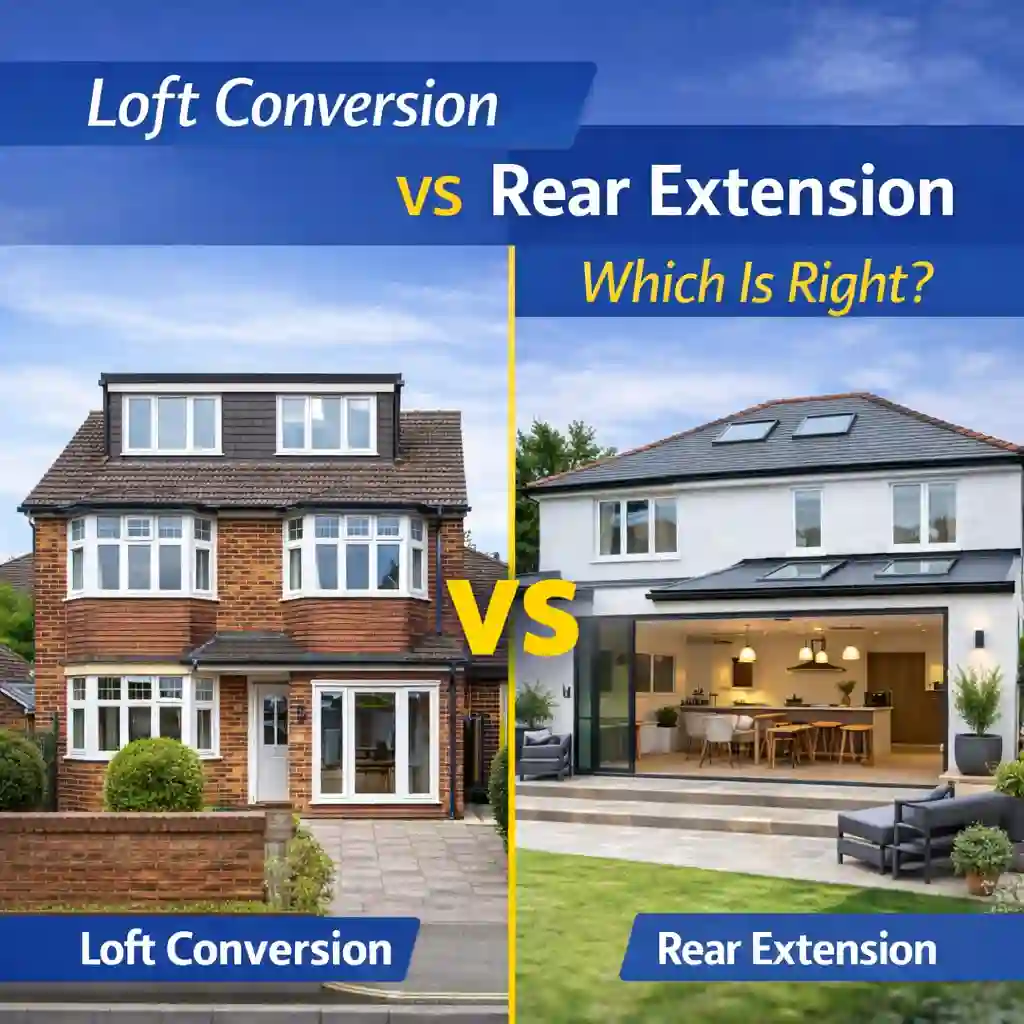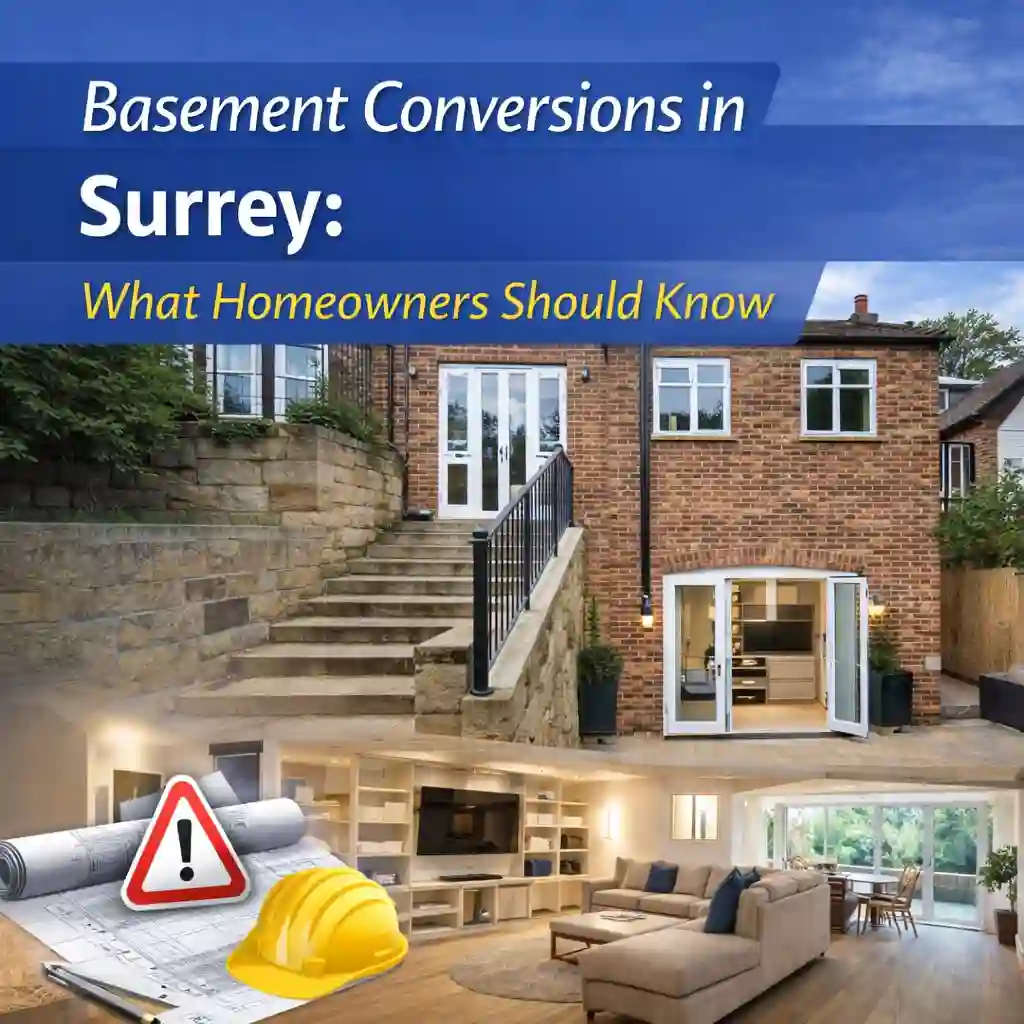
Basement projects can create valuable extra space where a loft or rear extension is not the right answer. They can also be among the most technically demanding forms of domestic work. If you are exploring a basement or cellar project in Surrey, the first question is not just can it be built? but what kind of basement are we really talking about? Converting an existing cellar is a very different proposition from excavating a brand-new basement below the house or garden. Planning, structural risk, party wall issues, waterproofing, ventilation and flood considerations can all change dramatically.

The main types of basement project
Understanding the type of project is the quickest way to understand likely complexity and cost.
| Project type | Likely planning position | Indicative build guide | Key technical issues |
|---|---|---|---|
| Finish or remodel an existing cellar | Planning permission is often unlikely if the external appearance and use are not changing materially. | Often around £700 to £1,500 per m² for finishing, or roughly £750 to £1,400 per m² for converting an existing cellar. | Waterproofing, ventilation, head height, fire safety, services and final quality of accommodation. |
| Remodel deeper / lower floor level with underpinning | Planning position depends on the extent of external and structural change; technical scrutiny rises sharply. | Often around £1,500 to £2,000 per m² as a broad guide for lowering and underpinning an existing cellar. | Underpinning sequence, structural design, neighbour protection, drainage and programme risk. |
| Create a new basement under the house | Full planning permission is commonly required. | Often around £2,000 to £3,000 per m² as an early guide, with site-specific projects going well beyond this. | Major excavation, retaining structures, waterproofing, access, spoil removal and significant neighbour/interface risk. |
| Create basement space under the garden | Usually planning-led and highly site-specific. | Often around £1,500 to £2,000 per m² as a broad feasibility guide. | Ground conditions, retaining walls, drainage, landscaping reinstatement and daylight/access design. |
Existing cellar conversion or brand-new basement?
If you already have a usable cellar footprint, converting it can be a much more controlled route than digging a completely new level. Planning Portal guidance indicates that converting an existing basement into living space is often less likely to require planning permission, provided you are not creating a separate dwelling, materially changing the use, adding a lightwell or altering the external appearance.
By contrast, excavating to create a new basement is much more likely to need planning permission and early local authority discussion. It is bigger work, with more structural, neighbour and programme risk.
Why basement projects are technically demanding
A basement is not just another room below ground. You are dealing with retained earth, groundwater risk, waterproofing strategy, ventilation, escape considerations, services, drainage and the long-term durability of the structure.
This is why basement projects usually benefit from early coordination between the designer, structural engineer, waterproofing specialist and contractor. Decisions made in concept stage can determine whether the finished space feels like a high-quality part of the home or a compromised afterthought.
The approvals that matter most on basement projects
Planning is important, but basements usually succeed or fail on the total approvals strategy rather than on planning alone.
| Approval / issue | Why it matters | Common trigger on basement projects |
|---|---|---|
| Planning permission | Controls the principle, external appearance and local planning impacts. | New basement excavation, visible lightwells, front lightwells, major external changes or creation of separate accommodation. |
| Building regulations | Controls structural safety, fire, damp proofing, ventilation, electrics and other technical matters. | Almost every habitable basement conversion or new basement build. |
| Party Wall etc. Act 1996 | Protects adjoining owners and creates a framework for excavation and structural works near neighbours. | Underpinning, excavation near neighbouring foundations, works to shared walls or structures. |
| Flood risk and drainage | Basements and below-ground spaces are sensitive to water risk and surface drainage issues. | Sites in relevant flood-risk zones or with significant drainage constraints. |
| Utilities and drainage diversions | Underground services and drainage routes can heavily affect design and cost. | Tight suburban plots and older properties with legacy pipe runs. |
Party wall and excavation risk often become central
For homeowners in tighter urban and suburban settings, basement projects frequently engage Section 6 of the Party Wall etc. Act 1996. That is the part of the Act dealing with excavation and construction close to adjoining buildings.
In practical terms, if you are excavating close to a neighbour’s building and deeper than their foundations, or within the wider 6-metre geometry test in the Act, you may need to serve notice before works begin. This is one reason basement schemes should not be rushed into without a properly coordinated technical review.
Flood risk and water management are not side issues
Below-ground spaces and water risk are obviously linked. The Environment Agency has standing advice on flood risk assessments for planning applications, and Elmbridge also directs applicants to flood-risk and sustainable drainage guidance where relevant.
That does not mean every basement site is unsuitable, but it does mean water management should be treated as a primary design issue rather than a late-stage bolt-on. On constrained or flood-affected sites, this can materially influence whether a basement is sensible at all.
When a basement is often a strong idea — and when it may not be
This is a practical homeowner decision table, not a substitute for engineering or planning advice.
| Scenario | Basement may be a strong fit | Basement may be a poor fit |
|---|---|---|
| Need for more space without losing garden | Yes — especially where above-ground extension options are constrained. | Less compelling if a simpler loft or rear extension would solve the brief more cheaply. |
| High-value location and long-term ownership | Often yes, because better space may justify the complexity. | Less attractive if resale horizon is short and the scheme is heavily cost-driven. |
| Property with an existing cellar | Often stronger, because you are improving existing footprint rather than excavating from scratch. | Still weaker if head height, damp or access problems are severe. |
| Tight site with sensitive neighbours | Possible, but requires careful planning and party wall strategy. | Riskier if access, spoil removal and neighbour protection become overwhelming. |
| Flood-sensitive or drainage-constrained setting | Only with great care and suitable technical advice. | Potentially the wrong route if water risk becomes too onerous. |
Frequently Asked Questions
No. Finishing or converting an existing cellar often has a different planning position from excavating a brand-new basement. External changes, lightwells, new residential units and major excavation make planning permission more likely.
They can be. Even relatively straightforward cellar conversions involve specialist work, and deeper excavation or new basements can become significantly more expensive than above-ground extensions.
Very often, yes. Excavation and structural works near adjoining buildings are one of the classic triggers under the Act.
Structure, waterproofing, drainage, ventilation, fire safety, light and long-term durability all matter. A basement that is technically under-considered can become a costly problem.
Potentially, but the finished room must satisfy the relevant planning, building regulations and design requirements for safe, usable accommodation. Bedrooms below ground need particularly careful attention to light, ventilation and escape strategy.
They can be more sensitive to flood and drainage issues, which is why water risk should be considered early rather than late.
A cellar conversion upgrades existing below-ground space. A basement excavation creates or enlarges below-ground space through major structural and groundworks operations. The latter is usually more complex, expensive and approval-heavy.
Establish the site constraints, understand whether you already have usable below-ground space, and get early coordinated advice on planning, structure, party wall and water management before you fall in love with a layout.
Thinking about a basement in Surrey?
If you are weighing up whether a basement is the right route, it helps to compare it against other options such as a loft conversion, a house extension or a staged whole-home approach. We can help you assess the technical and practical route before you commit.