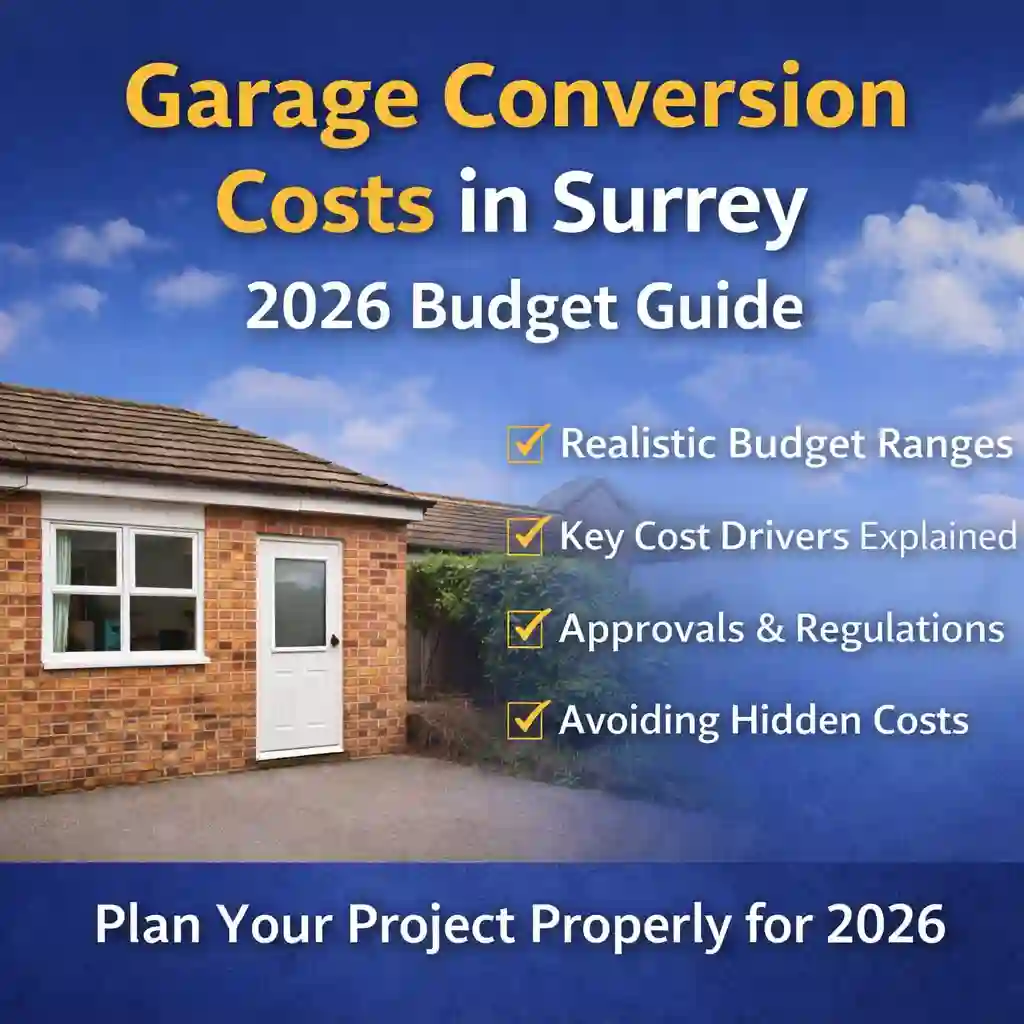
That is why a realistic garage conversion budget should look beyond the old garage door opening and the plaster finish. Floor build-up, insulation, structural suitability, ventilation, electrics, heating, drainage and how the new room connects to the main house can all move the cost significantly. If you are still comparing routes, it is also worth reading our earlier guide on garage conversion vs rear extension.
The short answer
For a straightforward habitable-room conversion in 2026, a sensible early working budget is often in the low-to-mid five figures, with integral garages usually coming in lower than detached garages. Costs typically rise when the project involves a bathroom, heavier structural work, a major Building Regulations upgrade, or a larger reconfiguration that connects the garage more fully to the rest of the property.
In other words, a simple office, playroom or snug conversion will usually budget very differently from a garage becoming a bedroom with shower room, or from a wider remodel that opens the garage into the kitchen or family-living space.
Typical budget ranges homeowners should allow for
| Garage type | Typical early budget range | What often affects the final cost |
|---|---|---|
| Integral garage | Usually the lowest-cost route | Insulation, floor levels, heating, front infill wall and the quality of the existing shell |
| Attached garage | Low-to-mid five figures in many cases | Knock-throughs, structural openings, service runs and integration with the house |
| Detached garage | Usually higher than integral or attached | Longer service runs, trenching, structural upgrades and intended end use |
| Double garage | Varies widely because of the extra area | Floor area, layout ambitions, heating strategy, bathrooms or utility spaces, and frontage alterations |
| Partial conversion | Often the most economical compromise | Whether you retain storage, add a WC / utility area, or upgrade only part of the envelope |
As a rule, the more the garage starts to behave like a true extension in specification or layout ambition, the more the cost moves upward. If you are also reviewing wider extension options, our House Extensions and Rear Extensions pages are useful comparison points.
What those headline figures usually include
A standard habitable-space conversion normally includes the infill of the garage door opening, wall and roof insulation upgrades, floor upgrading, new electrics, heating, plastering, joinery and basic finishes. In many homes, the work also includes replacing the front garage opening with a new wall and window arrangement so the room reads properly from both inside and outside.
What is often overlooked is that a garage shell is rarely ready-made habitable accommodation. The technical work hidden behind the finishes is often what decides whether the result feels like a proper room or a cold afterthought. That is why garage conversions should be assessed alongside Planning Permission Support, Building Regulations & Compliance and, where relevant, Party Wall Support.
Cost by garage type
Integral garage conversions
Integral garages are often the most economical because they already sit within the main building envelope. They usually benefit from easier access to existing services and can often be made to feel like part of the home more easily than a detached structure. They suit uses such as a home office, snug, playroom, guest room or accessible ground-floor bedroom.
Attached garage conversions
Attached garages can still be relatively efficient, but costs can move up quickly when the design includes a structural knock-through or when the garage is being absorbed into a larger open-plan space. This is one of the most common tipping points between a straightforward conversion and a wider remodel.
Detached garage conversions
Detached garages usually cost more because power, water, heating and drainage can all require longer runs and more site work. They can still make excellent offices, studios or guest spaces, but they tend to be less economical if the ambition is a fully serviced room with bathroom or kitchenette-style fit-out.
Double garage conversions
A double garage creates more design flexibility, but the increased floor area and potential complexity can place the budget closer to a small extension in some cases. That is why large double-garage projects should be weighed carefully against a rear or wrap-around extension, especially if the goal is broader family-living space.
Partial garage conversions
Partial conversions can be excellent value where homeowners still want some storage. A retained front storage bay, bike store or utility zone can make the project more practical while still releasing a useful new room inside the home.
Cost per square metre: useful, but only as a rough guide
Square-metre budgeting is helpful for a first pass, but it is not enough to price the job accurately. Small projects can still carry disproportionately high fixed costs if they require drainage changes, structural openings, premium glazing, a new heating strategy or remedial work to the shell. A garage conversion may be cheaper per square metre than a full extension, but the real number still depends on what is behind the plasterboard and under the floor.
The cost items homeowners most often miss
Infill of the garage door opening
Replacing the garage door with a proper wall and window is one of the most obvious budget items, but homeowners often underestimate the knock-on implications. The new wall must look right externally, perform thermally and sit correctly on suitable support below.
Floor upgrades
Garage floors are frequently colder, lower and less suitable for habitable use than the rest of the house. Raising levels, introducing insulation, dealing with damp-proofing and coordinating thresholds can all become meaningful cost items.
Heating, power and ventilation
Even where a garage already has a light and socket, it rarely has the services a proper habitable room needs. Radiators, underfloor heating, extra sockets, upgraded lighting, extractor fans and background ventilation can all be needed to make the room comfortable and compliant.
Plumbing and drainage
Costs rise noticeably when the conversion includes a WC, shower room, utility space or anything else that needs drainage runs and water services. This is one of the main reasons simple offices or snug conversions tend to budget very differently from guest suites or utility-heavy layouts.
Structural knock-through into the house
One of the biggest budget jumps comes when the garage is no longer treated as a stand-alone room and becomes part of a larger reconfiguration. Forming a new opening into the house, removing load-bearing walls or making the space part of a new kitchen-family room can materially change the cost profile.
Design, structural and approval costs
Early feasibility work, drawings, structural input and approval costs are easy to forget in an online budget comparison. But these are often the items that prevent costly surprises later. If you want a clearer route from concept to delivery, our Our Process page explains how HWP sequences design, approvals and build planning.
Why some garage conversions come in cheaply and others do not
The deciding factor is usually the existing structure. A sound, dry, well-located garage being converted into a simple additional room will usually price much more cleanly than a poor shell requiring floor remediation, frontage rebuilding, roof work, major service upgrades and structural alterations. This is why two conversions that look similar from the street can price very differently.
The intended end use also matters. A basic home office or playroom is one thing. A bedroom with shower room, a fully fitted utility room, or a converted garage forming part of a larger kitchen-living remodel is another.
Planning permission: often simpler, but not automatic
Many garage conversions are relatively straightforward from a planning point of view, especially where the work is mainly internal and the building is not enlarged. But that is not a blanket rule. Restrictions tied to the property, local design issues, frontage changes, parking-related conditions or a proposal that starts to function as a separate unit can all change the planning picture.
If you are working in Elmbridge or nearby, it is sensible to cross-check our existing insight on planning permission for house extensions in Elmbridge and get project-specific advice before site costs are committed.
Building Regulations: where many of the real costs sit
This is where many garage conversion budgets either become realistic or fall apart. Once a garage is being turned into habitable accommodation, the project usually needs to deal with issues such as thermal performance, ventilation, structure, floor build-up, damp protection, fire safety and electrical compliance.
That is why a garage conversion should not be priced as if it were simply cosmetic work. HWP’s service page for Building Regulations and our insight on building regulations in 2026 are both useful supporting reads if you want to understand where technical scope turns into real cost.
Will party wall matter on a garage conversion?
Not always, but it can. If the project involves work to a shared wall, construction close to a boundary, or excavation and foundations near an adjoining owner’s structure, party wall considerations can arise. This is more likely on certain attached garages or where the conversion is part of a larger structural redesign rather than a simple internal upgrade.
For that reason, it is worth reading our existing guides on party wall agreements and loft conversions in Elmbridge and party wall notices for rear or side return extensions, especially if the garage conversion is tied into wider extension works.
How long does a garage conversion usually take?
The on-site phase is often quicker than a full extension, but the real programme still depends on the design stage, technical detailing, approvals, contractor availability and the complexity of the scope. A straightforward room conversion is usually much faster than a garage conversion that includes a bathroom, structural opening or wider refurbishment.
The safest assumption is that the project has two timeframes: the design and approvals phase and the site phase. The build itself may be relatively short, but good projects still need proper lead-in.
At-a-glance budget checklist
- Confirm whether the garage is integral, attached, detached, double or only being partially converted.
- Check the condition of the floor, roof, walls and existing garage door opening before pricing assumptions are fixed.
- Allow for insulation, damp-proofing, heating, electrics and ventilation rather than focusing only on finishes.
- Budget separately for bathrooms, utility spaces or any plumbing-heavy specification.
- Allow for knock-through costs if the garage is being opened into the main house.
- Check the planning and Building Regulations route early rather than assuming the project is paperwork-light.
- Consider whether party wall issues could arise if the works affect a shared wall or nearby boundary structure.
Frequently asked questions
What is a realistic budget for a single garage conversion in Surrey?
For many homeowners, the right starting point is a low-to-mid five-figure allowance, with the final figure depending on garage type, structural condition, services, finish level and whether the room remains simple or becomes more ambitious.
What is usually the cheapest type of garage conversion?
Integral garage conversions are often the most economical because they already sit within the main house envelope and are usually easier to connect to existing services.
Why do detached garage conversions often cost more?
They often need longer service runs, more site work and sometimes more structural upgrading, which can make them less economical than attached or integral garages.
Does a garage conversion usually need planning permission?
Not always, but it should never be assumed. Restrictions linked to the property, local constraints or the intended use of the converted space can change the answer.
Does a garage conversion usually need Building Regulations approval?
In most cases, yes. Once the space becomes habitable, issues such as insulation, ventilation, structure, floor performance, damp protection and fire safety usually need to be dealt with properly.
What usually pushes the cost up most?
The biggest cost drivers are garage type, structural condition, plumbing-heavy layouts, frontage rebuilding, knock-throughs into the house and the overall technical standard needed to make the room feel like a real part of the home.
Related reading
- Garage Conversions in Elmbridge & Surrey
- Garage Conversion vs Rear Extension: Which Adds Better Value?
- House Extension Costs in Surrey: What Homeowners in East Molesey Should Budget For
- Do I Need Planning Permission for a House Extension in Elmbridge?
- Wrap-Around Kitchen Extension East Molesey KT8
Thinking about a garage conversion in Surrey?
If you want practical advice on scope, approvals, likely costs and whether a garage conversion is the right route for your home, explore our Garage Conversion, Building Regulations and Planning Permission pages, or get in touch for a fixed-price quotation.
You can also review recent homeowner feedback on our Reviews page before taking the next step.