The catch is that “better value” is not just about headline resale uplift. It depends on how you use the new space, whether you lose useful parking or storage, what buyers expect in your street, and how well the project fits the existing house. In practical homeowner terms, a garage conversion often adds better value per pound spent, while a rear extension can add stronger overall family-home value where the current ground-floor layout is the real weakness.
The short answer
Choose a garage conversion if the garage is underused, off-street parking remains available and you want an extra room without the cost and disruption of a full extension. Choose a rear extension if the main problem is a cramped kitchen, weak dining space or poor connection to the garden, and the project can create a layout that feels significantly better for modern living.
The best option is rarely the one with the biggest headline promise. It is usually the one that solves the biggest weakness in the house while still making sense in planning, design, parking and budget terms.
What “better value” really means
Homeowners often treat value as if it were just one number. In reality, there are several separate questions:
- Which option costs less to build?
- Which option is more likely to improve the property’s saleability?
- Which option gives the best day-to-day improvement while you are still living there?
- Which option carries the lowest risk in planning, building regulations, parking and neighbour terms?
A lower-cost project can be excellent value even if it does not produce the highest theoretical resale uplift. Equally, a more expensive project can still be better value if it solves the core layout problems that are holding the whole house back.
Why a garage conversion can be the smarter value move
The biggest attraction is efficiency. Because the structure already exists, a garage conversion usually avoids the cost of a full new roof, substantial new wall construction and entirely new foundations. That is why it can be such an effective route for households that need a home office, snug, playroom, guest room, utility space or ground-floor bedroom without moving or embarking on a much larger build.
It can also be a simpler approval route in many cases. If you are reviewing feasibility, it is worth looking at the current HWP service pages for Garage Conversions, Planning Permission Support and Building Regulations & Compliance together rather than in isolation.
Where garage conversions usually perform well
A garage conversion is often a strong value choice where the garage is attached or integral to the house, the household already has a driveway or other reliable parking, and the finished room solves an obvious weakness in the current layout. A well-designed extra bedroom, office, family room or utility-boot-room combination can be highly practical because it adds habitable space without reducing garden depth.
It is particularly persuasive where the garage is not truly functioning as a garage. Many attached garages end up storing bikes, tools, boxes and overflow appliances rather than housing a car. If that is already the reality, converting the space properly may create a more valuable outcome than preserving an underused room in its current form.
Why a rear extension can create stronger overall value
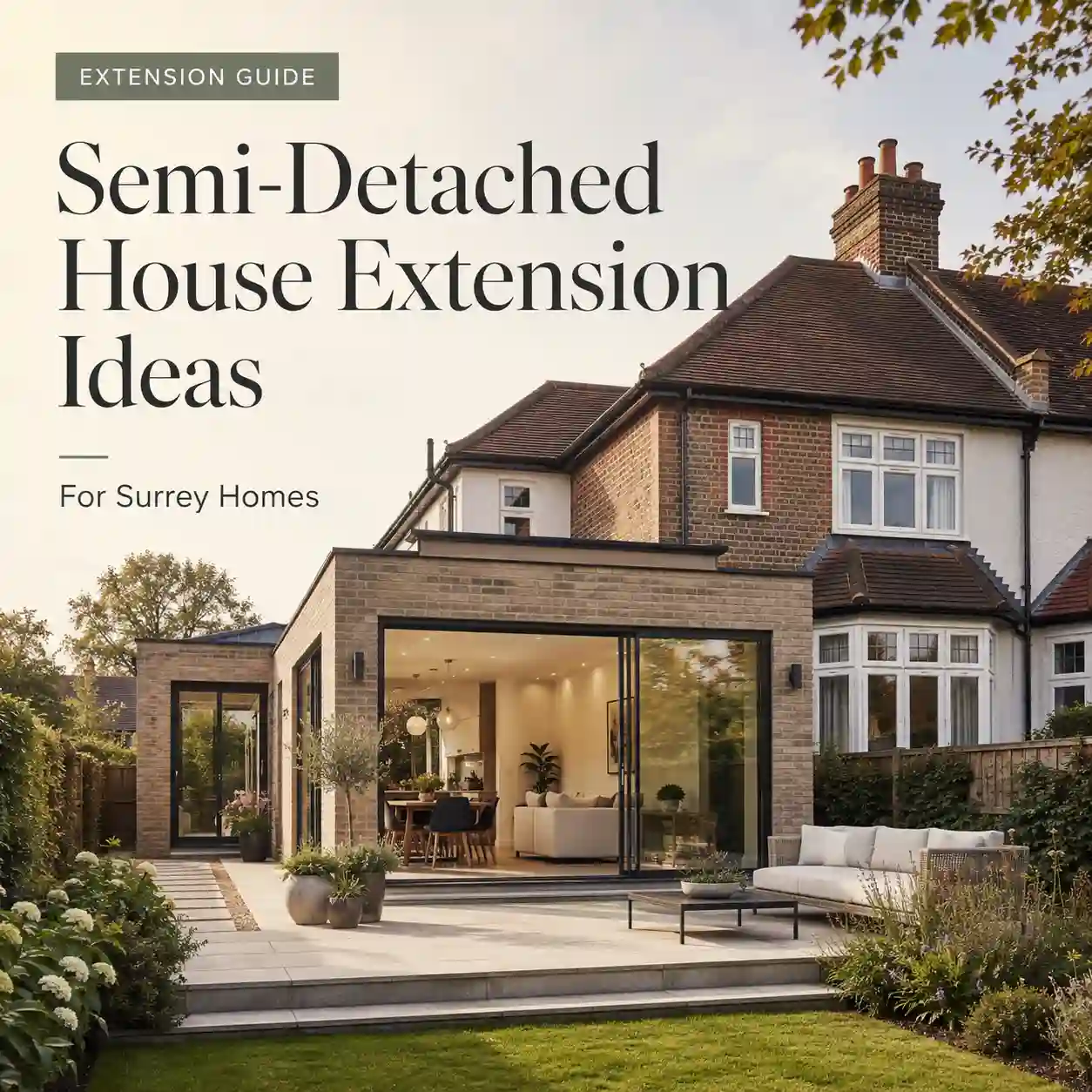
A rear extension is usually the bigger intervention, but that is exactly why it can be the more powerful one. If the house suffers from a cramped kitchen, poor circulation, limited dining space or weak connection to the garden, a rear extension can improve the part of the home that often matters most to families and future buyers.
Unlike a garage conversion, a rear extension is not limited by the existing footprint of one enclosed ancillary space. It can create a larger kitchen-dining-family room, bring in more daylight, replan circulation and make the whole ground floor feel more coherent. In the right house, that can be more valuable than simply adding one extra enclosed room.
When rear extensions tend to outperform
Rear extensions often come out ahead when the kitchen is too small for modern family life, the house lacks a strong central living space, or buyers in the area expect an open and well-connected rear family room. They also tend to make more sense where the garage is genuinely useful, because keeping that parking or storage and extending elsewhere can preserve more of the property’s overall appeal.
If you are comparing wider extension feasibility, it may help to read HWP’s existing guides on house extension costs in Surrey and planning permission for house extensions in Elmbridge.
The parking question can change the answer completely
The single biggest risk with a garage conversion is losing something buyers genuinely value. If on-street parking is difficult, heavily restricted or expensive, removing a functional garage can weaken the resale story. In those cases, a rear extension may be the safer long-term value decision even if it costs more to build.
Garage conversions tend to look stronger where there is a driveway, a second parking space, or where the garage is too small for modern vehicles and is already used mainly as storage. The more easily you can preserve practical parking after the conversion, the easier it is to make the value case.
Cost versus resale: do not confuse the two
Garage conversions often look better on a simple return-on-cost basis because the starting cost is usually lower. Rear extensions can still be the better investment in absolute value if they materially improve how the house works, make the kitchen and living space more attractive, and bring the property closer to what buyers expect in the local market.
That is why the real question is not only, “Which one costs less?” It is also, “Which one makes this specific house more desirable in this specific location?” The strongest answer usually comes from looking at planning position, parking, layout, build cost and future buyer expectations together.
At-a-glance comparison
| Factor | Garage conversion | Rear extension |
|---|---|---|
| Typical cost-efficiency | Often stronger because the shell already exists | Usually more expensive because it involves new foundations and structure |
| Potential lifestyle impact | Adds one useful room quickly | Can transform the whole rear of the house |
| Planning complexity | Often simpler if mainly internal | Can still be straightforward, but commonly needs more planning review |
| Building regulations | Usually required for habitable conversion | Usually required |
| Parking impact | Can be negative if the garage is genuinely valuable | Usually preserves existing parking if the garage stays |
| Best suited to | Homes needing one extra room with tighter budgets | Homes needing a better kitchen / family-living layout |
Elmbridge-specific considerations
For Elmbridge homeowners, the safest route is to check the planning position early rather than rely on assumptions. A garage conversion may look simple until a parking-related condition, street-scene issue or wider planning constraint appears. A rear extension may look straightforward until prior approval, neighbour amenity, conservation area or design issues need more careful handling.
It is also worth separating planning, technical design and cost planning into distinct decisions. For example, a rear extension may be acceptable in principle but still need careful coordination on structural openings, rooflights, glazing, drainage and the route to building control sign-off. HWP’s Our Process page is a useful starting point if you want to understand how that sequence is usually managed.
Which project is usually better for different goals?
Best value for a limited budget
A garage conversion often has the edge because the structure is already there and the cost base is usually lower.
Best long-term family layout
A rear extension often wins because it can reshape the kitchen and living arrangement in a way a garage conversion usually cannot.
Fastest route to one extra room
A garage conversion is usually the simpler route if the space is structurally suitable and parking remains workable.
Strongest option where parking is prized
Keeping the garage and extending to the rear may be the safer decision where on-street parking is difficult and buyers genuinely value protected parking or secure storage.
Common mistakes to avoid
- Assuming a garage conversion is automatically permitted development in every case.
- Treating a garage conversion as cosmetic work rather than a proper habitable-space project.
- Assuming a rear extension is automatically better value because it is bigger.
- Ignoring the effect of lost parking on future buyer appeal.
- Comparing only build cost and not day-to-day usefulness, layout quality and resale logic.
Frequently asked questions
Does a garage conversion usually cost less than a rear extension?
Usually yes. A garage conversion normally reuses the existing shell, so it often avoids the cost of substantial new foundations and external walls.
Does a garage conversion still need Building Regulations approval?
In most cases, yes. Once a garage is being converted into habitable accommodation, issues such as insulation, ventilation, floor build-up, structural suitability and fire safety usually need to be dealt with properly. See HWP’s Building Regulations service and building regulations guide for wider context.
Can a rear extension be permitted development?
Sometimes, yes, but it depends on the property type, scale, location and any applicable conditions or restrictions. This should be checked properly rather than assumed.
Which one adds more value?
There is no fixed answer. Garage conversions often add better value per pound spent, while rear extensions can add stronger overall value where they materially improve the main living spaces.
Which one is better for a family home?
If the current kitchen and living layout is the real problem, a rear extension is often the stronger family-home solution. If the house simply needs one more flexible room, a garage conversion may be the better fit.
Related reading
- Garage Conversions in Elmbridge & Surrey
- Rear Extensions in Elmbridge & Surrey
- House Extension Costs in Surrey: What Homeowners in East Molesey Should Budget For
- Loft Conversion vs Rear Extension: Which Adds More Usable Space and Value?
- Wrap-Around Kitchen Extension East Molesey KT8
Need help deciding between a garage conversion and a rear extension?
If you want practical advice on layout, approvals, budget and the best long-term route for your home, explore our Garage Conversion, Rear Extension and House Extensions pages, or get in touch for a fixed-price quotation.
You can also review recent homeowner feedback on our Reviews page before taking the next step.