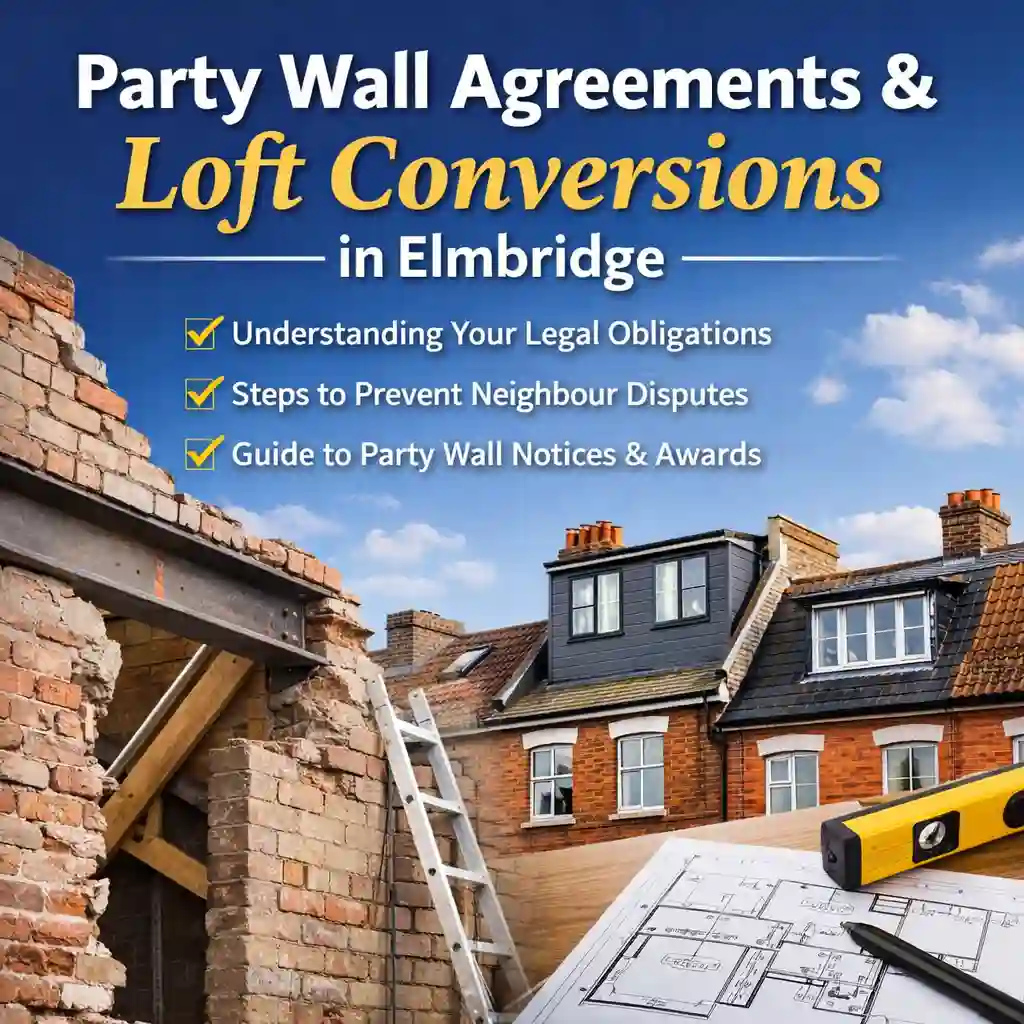

In everyday conversation, homeowners often use the phrase party wall agreement to describe the whole process. In practice, the legal process usually starts with a party wall notice. If the adjoining owner consents in writing, works may proceed on that basis. If they dissent, or if a dispute is deemed to arise under the Act, surveyor(s) can prepare a party wall award setting out how the works should proceed. This article is written as general information for homeowners considering loft work to houses in England and Wales. It is not project-specific legal advice.
What is a party wall?
A party wall is not simply any wall near a boundary. Broadly, it is either a wall that stands astride the boundary between two owners, or a wall that stands wholly on one owner’s land but is used by both owners to separate their buildings. The Act also uses the wider term party structure, which can include certain other separating structures. A wall built wholly on one owner’s land is not automatically a party wall just because it is close to the boundary.
This matters because some loft conversions do trigger the Act and some do not. The answer depends on the structural design and the nature of the work rather than the general label of “loft conversion”.
Why loft conversions often trigger the Party Wall etc. Act 1996
Many loft conversions in semi-detached and terraced houses rely on steelwork bearing into the wall separating the two homes. That is one of the clearest examples of work that can fall within the Act. The same is true where the design involves raising the party wall, removing chimney breast projections, or carrying out notifiable excavation near the adjoining owner’s building.
In practical terms, this is why party wall should be checked early alongside design, structure and programme. If the design team identifies a party wall requirement too late, an intended start date can quickly become unrealistic.
Loft conversion works most likely to need notice
- Cutting into a party wall to support steel beams for a new loft floor.
- Raising the height of the party wall as part of the loft design.
- Removing or cutting back projections such as a chimney breast where relevant.
- Underpinning or deeper structural work affecting the party wall.
- Excavation near the adjoining owner’s building where the statutory section 6 tests are met.
A dormer loft conversion or mansard loft conversion may well involve party wall issues, but even a simpler rooflight loft can still require notice if the structural design needs beams into the separating wall. A fuller overview of loft options is available on our Loft Conversions page.
Planning permission, permitted development, building regulations and party wall are separate issues
This is one of the biggest homeowner misconceptions. A loft conversion may be lawful in planning terms and still require party wall compliance. Likewise, party wall compliance does not remove the need for planning permission or building regulations approval where required.
For houses, many loft conversions can fall under permitted development if the relevant limits and conditions are met, but that is not universal. The Planning Portal guidance is aimed at houses and sets out important limits including roof-volume limits, materials, roofline restrictions and window privacy rules. Flats, maisonettes and listed buildings need separate checks and often a different planning route. Elmbridge Borough Council also notes that homeowners can seek a lawful development certificate if they want formal confirmation that proposed works are lawful.
For lofts that will become liveable space, Building Regulations support is typically needed for structure, fire safety, stairs, insulation and sound separation. Planning and compliance advice can also be explored through our Planning Permission support service.
Notice periods at a glance
| Type of matter | Typical relevance to loft conversions | General notice period |
|---|---|---|
| Section 2 works to an existing party wall or party structure | Steel beams into the wall, raising the wall, chimney breast work | At least 2 months |
| Section 6 excavation near a neighbouring building | Deeper foundations or excavation linked to wider structural works | At least 1 month |
Those notice periods should be built into the project programme. If you want to start work in spring or summer, party wall should not be left until the week before site setup.
Step-by-step: how the process usually works
1. Review the structural design early
The best point to assess party wall requirements is once the structural strategy is reasonably clear. That includes beam positions, staircase location, dormer or mansard geometry and any excavation linked to the wider scheme.
2. Identify the correct adjoining owner or owners
Notice must be served on all relevant adjoining owners. This can occasionally be more involved than people expect, especially where ownership is not straightforward or there are leasehold interests.
3. Serve the correct notice with enough detail
Notices should describe the proposed works properly. Where excavation is involved, the supporting information is usually more technical and should clearly show the location and depth of the proposed work.
4. Wait for the response period
Any agreement reached should be in writing. For relevant section 2 and section 6 notices, if the adjoining owner does not respond in writing within 14 days, a dispute can be deemed to arise under the Act and the surveyor process can begin.
5. Record the neighbouring property condition
A schedule of condition is not a strict statutory requirement, but it is highly advisable. It creates a written and photographic record of the adjoining property before work starts and can significantly reduce later disagreement.
6. If needed, surveyor(s) prepare an award
If the adjoining owner dissents, or a dispute is deemed to arise, the parties can appoint an agreed surveyor or appoint separate surveyors. The award can set out what work is to be carried out, how and when it is to be done, what protective measures are required and what records or inspections are needed.
What if your neighbour agrees, dissents or ignores the notice?
If the adjoining owner consents in writing, the process is usually more straightforward. If they dissent, the Act provides a dispute-resolution framework through surveyor(s); it does not simply mean the project ends. If they ignore the notice in circumstances where the Act says a dispute is deemed to arise, the surveyor route can still be used.
The real risk is starting work without following the Act where it applies. That can expose the building owner to injunction risk, delay and unnecessary neighbour conflict.
What a party wall award can and cannot do
A party wall award can deal with practical issues around the proposed works, including method, timing, protective measures and access for inspection. It can also help deal with compensation for loss or damage caused by relevant works.
However, it is not a substitute for every other legal issue. A party wall surveyor can make an award on matters covered by the Act, but cannot determine a boundary dispute. The Act also does not replace planning permission, building regulations, title matters, covenants or other property rights.
Who usually pays the surveyor fees?
In many loft conversion cases, the building owner pays the costs associated with drawing up the award, including the adjoining owner’s surveyor’s fees, where the works are solely for the building owner’s benefit. That is why it is sensible to budget for party wall costs early rather than treating them as a minor afterthought.
Elmbridge-specific points to keep in mind
In Elmbridge, the most useful early-stage question is not simply “Do I need planning permission?” but rather:
- Is the loft likely to fall within permitted development, or is a planning application more realistic?
- Should a lawful development certificate be obtained for clarity?
- Does the structural design trigger the Party Wall etc. Act 1996?
- What building regulations and fire-safety upgrades will be needed?
That joined-up approach is one reason integrated design and delivery matters. Where a loft scheme is part of a broader package of works, good coordination through Project Management can protect both programme and budget.
Common mistakes to avoid
- Assuming permitted development means no party wall process is needed.
- Leaving notice too late and then expecting the build date to stay unchanged.
- Assuming a neighbour’s silence means everything is fine.
- Skipping a schedule of condition.
- Treating party wall as a stand-alone admin task instead of part of the overall design-and-build sequence.
Frequently asked questions
Do all loft conversions in Elmbridge need a party wall agreement?
No. Some do and some do not. The answer depends on whether the design involves work covered by the Act, such as beams into a party wall, raising the wall or notifiable excavation.
How much notice should be given?
For typical loft-related work to an existing party wall under section 2, the usual notice period is at least two months. For excavation matters under section 6, the usual notice period is at least one month.
What if my neighbour does not reply?
In relevant section 2 and section 6 cases, if the adjoining owner does not respond in writing within 14 days, a dispute can be deemed to arise and the surveyor process can begin.
Does planning permission remove the need for a party wall notice?
No. Planning, permitted development, building regulations and party wall are separate regimes.
What if my property is a flat or maisonette?
The common loft permitted development rules often quoted for houses do not automatically apply to flats or maisonettes. Those properties need separate planning checks and may involve additional legal and management issues.
Can a party wall surveyor resolve a boundary dispute?
No. Boundary disputes are outside the scope of the Act and need a different route.
Related reading
- Loft Conversion Types Explained
- Building Regulations 2026 Homeowners Guide
- Do I Need Planning Permission for a House Extension in Elmbridge?
- Dormer Loft Conversion Surbiton KT6
- Mansard Loft Conversion Wimbledon SW19
Need help planning a loft conversion in Elmbridge?
If you are considering a loft conversion and want a joined-up approach to design, planning, structural coordination and neighbour-facing compliance, explore our Party Wall Support service or get in touch to discuss your project.